
Key Takeaways
Choosing where to have treatment abroad usually comes down to a handful of practical questions: is the hospital properly accredited, does it have genuine experience with international patients, and will someone actually manage the logistics? Apollo Hospitals is one of the most established answers to all three in India, with a track record built over four decades rather than a marketing claim built for one campaign.
· Apollo Hospitals was founded in Chennai in 1983 and has treated more than 150 million patients from over 150 countries since.
· Seven Apollo flagship hospitals hold Joint Commission International (JCI) accreditation, alongside 37 NABH-accredited hospitals across the group.
· Indraprastha Apollo Hospital, New Delhi, was India’s first JCI-accredited hospital (2005) and has been re-accredited four consecutive times.
· Apollo’s network covers cardiac care, oncology (including proton therapy), transplantation, orthopedics, neurology, and dozens of other specialties under one group.
· Treatment costs in India are commonly cited as 40% to 80% lower than equivalent private care in the US, UK, or similar Western countries, though actual costs vary by case.
· For Kuwait-based patients, Apollo Clinic in Mahboula can serve as the local starting point for accessing specialist care at Apollo Hospitals in India.
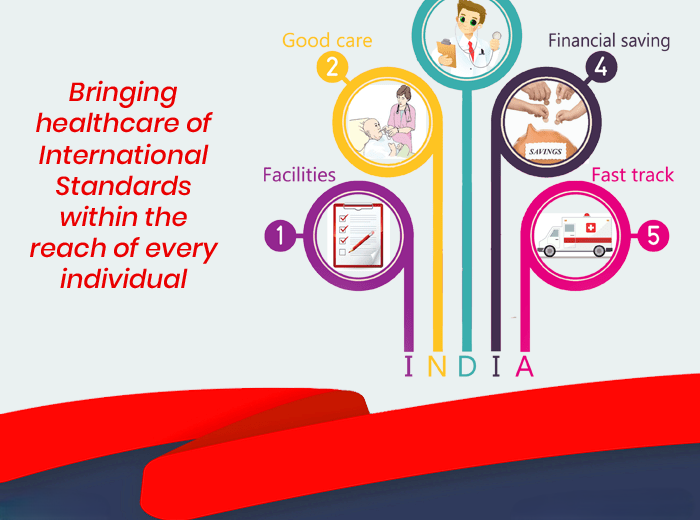
Why International Patients Consider India for Treatment
Before looking at any specific hospital, it helps to understand why India has become one of the world’s leading medical tourism destinations in the first place. Alongside destinations such as Thailand and Singapore, India draws patients for a combination of reasons: significantly lower treatment costs than in Western countries, English-speaking clinical staff, shorter waiting times for elective procedures, and a deep bench of specialists in high-demand areas such as cardiac surgery, oncology, transplantation, and orthopedics. Internationally recognised hospital accreditation — JCI in particular — gives patients a way to judge quality and safety standards before committing to treatment thousands of kilometres from home.
Apollo Hospitals at a Glance
Fact | Detail |
Founded | 1983, in Chennai, by Dr. Prathap C. Reddy — India’s first corporate healthcare provider |
Patient volume | Over 150 million patients treated, from more than 150 countries, over 40+ years |
JCI accreditation | 7 flagship hospitals JCI-accredited; Indraprastha Apollo, New Delhi, was India’s first (2005), re-accredited 4 consecutive times |
NABH accreditation | 37 NABH-accredited hospitals across the group |
Specialty scope | Cardiology, oncology and proton therapy, transplantation, orthopedics, neurology, nephrology, gastroenterology/hepatology, IVF, pediatrics and more |
Digital follow-up | Apollo 24/7 platform for remote consultations and post-treatment follow-up |
What Sets Apollo Apart for International Patients
Accreditation That Means Something
Hospital accreditation is one of the few objective ways an international patient can judge safety standards before travelling. JCI accreditation in particular is widely treated as the international benchmark, covering everything from medication safety protocols to infection control audits and surgical safety checklists. Apollo’s flagship hospitals have held this accreditation for years, not as a one-time achievement but through repeated re-accreditation cycles — Apollo Chennai and Apollo Hyderabad, for example, both completed their seventh consecutive JCI re-accreditation in 2024.
A Genuinely Broad Specialty Network
Many patients travelling for treatment need more than one type of care — a cardiac patient may also be managing diabetes, a transplant candidate needs nephrology support, an oncology patient needs radiology, anaesthesia, and intensive care coordinated together. Apollo’s model keeps this within one integrated network rather than requiring patients to coordinate between separate facilities. The network’s scope includes:
· Cardiology, cardiac surgery, and catheter-based interventions
· Oncology, including surgical and radiation oncology, and proton therapy at Apollo Proton Cancer Centre, Chennai
· Organ transplantation — liver, kidney, heart, and bone marrow
· Orthopedics, joint replacement, and spine surgery
· Neurology and neurosurgery
· Gastroenterology, hepatology, and hepatobiliary surgery
· Nephrology and urology, IVF and fertility care, and pediatric care
· Robotic-assisted surgery across several of the above departments
Technology That Supports Complex Cases
Beyond individual specialties, Apollo’s hospitals are equipped with technology that matters specifically for complex or advanced cases: robotic surgical platforms that can reduce hospital stay in eligible cases, advanced imaging such as PET-CT and high-resolution MRI, dedicated cath labs for cardiac intervention, and critical care units staffed by specialist intensivists. Apollo Proton Cancer Centre in Chennai adds a treatment option — proton therapy — that remains available at only a small number of centres worldwide.
A Team Dedicated to International Patients
Medical travel involves more than the treatment itself: sharing records with the right specialist, understanding a cost estimate, arranging a medical visa, planning accommodation, and setting up follow-up care before you’ve even booked a flight. Apollo’s International Patient Services (IPS) team is built specifically around this journey, typically supporting patients with medical query review and specialist matching, treatment estimates, visa documentation support, airport pickup and accommodation guidance, admission coordination, and continued follow-up after the patient returns home.
Continuity of Care After You Return Home
One of the most overlooked parts of planning treatment abroad is what happens after discharge. A clear plan for medication, wound care, warning signs to watch for, and a way to share follow-up reports with the treating team matters just as much as the procedure itself. Apollo’s IPS model is built to continue after the patient leaves India, and the Apollo 24/7 digital platform allows video follow-up consultations with the treating doctor from wherever the patient is based.
Understanding the Cost Advantage
Cost is one of the most practical reasons patients consider India for treatment. Across the medical tourism industry, India is consistently cited as offering treatment at roughly 40% to 80% lower cost than equivalent private care in the United States, United Kingdom, or similar Western healthcare systems, particularly for procedures such as cardiac surgery, joint replacement, organ transplantation, and cancer treatment including proton therapy. That said, the exact cost for any individual case depends on the diagnosis, chosen procedure, doctor team, room category, length of stay, and any implants or devices required. A written estimate from the treating hospital, after reviewing the specific case, is the only reliable way to know actual costs — general ranges should be treated as a starting point for research, not a quote.
What the Medical Tourism Journey Typically Looks Like
While every case is different, international treatment at a hospital like Apollo generally follows a similar sequence:
1. Sharing diagnosis reports, scans, and treatment history for initial review by the hospital’s international patient team.
2. Receiving a specialist opinion and, where appropriate, a written treatment plan and cost estimate.
3. Arranging a medical visa, flights, and accommodation, often with guidance from the hospital’s international patient services team.
4. Travelling for an in-person consultation, any additional tests, and admission if surgery or inpatient treatment is required.
5. Undergoing treatment, with recovery support and clear discharge instructions before leaving hospital.
6. Continuing follow-up care from home through report sharing and remote consultations with the treating team.
Documents Worth Having Ready
Patients travelling for treatment generally need: a valid passport and medical visa where required, complete medical reports and scans (MRI, CT, PET-CT, X-ray as applicable), a current medication and allergy list, previous surgery records and discharge summaries, a referral letter from a home-country physician if available, insurance documentation if applicable, and confirmed appointment details from the hospital’s international patient team.
How Kuwait-Based Patients Can Access Apollo Hospitals via Apollo Clinic Kuwait.
For patients based in the Kuwait, the practical first step in exploring treatment at Apollo Hospitals in India is usually a local consultation rather than booking travel directly. Apollo Clinic Kuwait can support this process along a typical pathway:
1. Initial consultation at Apollo Clinic Kuwait to discuss the condition and share existing medical records, scans, and test results.
2. Case review by the relevant specialist team in India, with a treatment recommendation and cost estimate shared before travel.
3. Coordination of travel logistics, medical visa support, and appointment scheduling for the visit to India.
4. Treatment delivered at the appropriate Apollo facility in India, based on the specialty required.
5. Post-treatment follow-up coordinated between the treating team in India and Apollo Clinic Kuwait where possible, supported by Apollo 24/7 for remote consultations.
Conclusion
Apollo Hospitals’ case for medical tourism rests on verifiable fundamentals rather than marketing alone: four decades of operation, internationally recognised accreditation held and repeatedly renewed, a genuinely broad specialty network, and a support structure built specifically around the practical difficulties of travelling for treatment. None of that replaces the need for individual due diligence — every patient should still request a written specialist opinion, a clear cost estimate, and a concrete follow-up plan before travelling. For Kuwait-based patients, Apollo Clinic Kuwait offers a straightforward way to begin that process locally before any travel decision is made.
Frequently Asked Questions
What makes Apollo Hospitals a common choice for medical tourism specifically?
A combination of long-standing JCI and NABH accreditation, a broad specialty network under one group, over four decades of experience treating international patients, and a dedicated International Patient Services team that manages the logistics around treatment, not just the treatment itself.
Are all Apollo Hospitals JCI-accredited?
No. Seven of Apollo’s flagship hospitals hold JCI accreditation, alongside 37 hospitals across the group accredited by India’s National Accreditation Board for Hospitals (NABH). It’s worth confirming which specific hospital and department holds current accreditation for your intended treatment.
How much Cost affective in India compared to the US or UK?
Industry estimates commonly cite 40% to 80% lower costs for comparable private treatment, though the exact figure depends heavily on the specific procedure, hospital, and individual case. A written estimate from the treating hospital is the only reliable way to know actual costs.
Does Apollo help with visas and travel logistics?
Yes. Apollo’s International Patient Services team from India typically assists with medical visa documentation, treatment estimates, accommodation guidance, and admission coordination, though the exact scope of support can vary by hospital and case.
What happens after I return home from treatment?
Apollo’s model includes structured follow-up support, including report sharing and remote video consultations through the Apollo 24/7 platform, so recovery can continue to be monitored by the treating team after the patient leaves India.
How does a Kuwait-based patient start the process?
Typically with a consultation at Apollo Clinic Kuwait, where medical records are reviewed and shared with the relevant specialist team in India to determine a treatment plan and estimate before any travel is arranged.
Medical and Travel Disclaimer
This article is intended for general information only and does not replace professional medical advice or an individualised treatment recommendation. Accreditation status, treatment costs, and hospital capabilities can change; please confirm current details directly with the hospital’s international patient services team before making any travel decision.